 Paper Predict Notes
How to choose the right notes for NEET
Most NEET aspirants end up with too many books and not enough revision. This is a practical checklist for choosing notes that actually match how NEET is set.
Paper Predict Notes · 20 Jun 2026
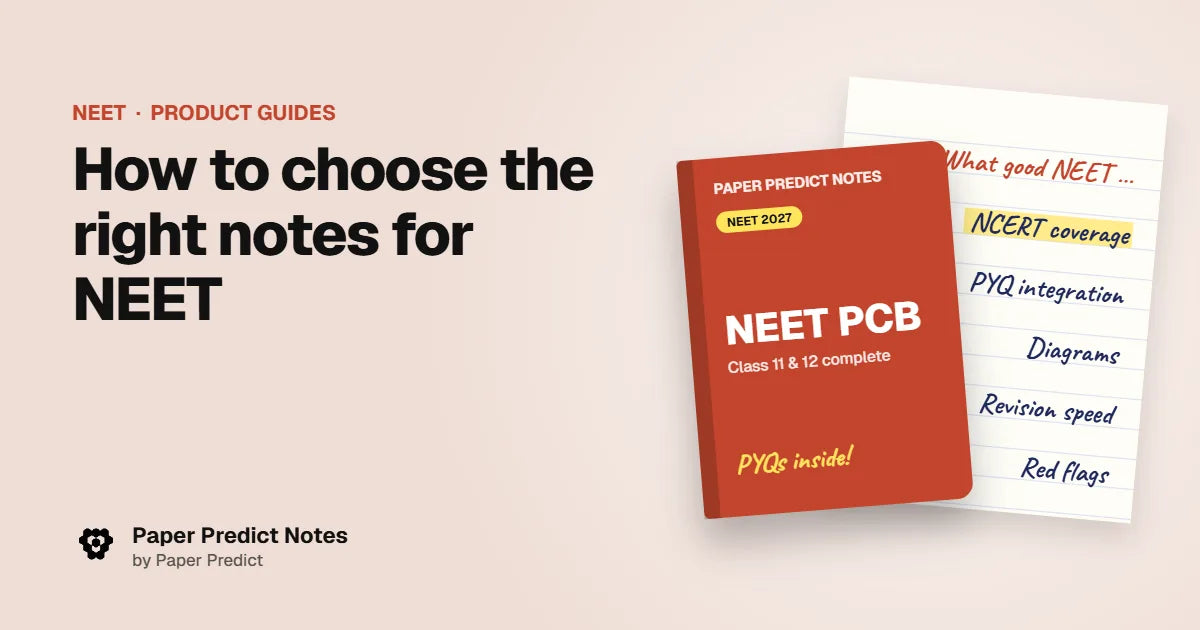
By the middle of their NEET preparation, most students own far more material than they can use. There are coaching modules, NCERT textbooks, a couple of reference books, PDFs from friends, screenshots from Telegram groups and printed question banks. The problem is rarely a lack of material. It is not knowing which one to trust for revision.
Good notes solve that problem. They become the single place you return to in the final months, when there is no time to open five books for one chapter. This guide explains what NEET notes should contain, how to check a set before you commit to it, and how to use notes alongside NCERT and practice material.

Start with how NEET is set
Choosing notes is easier once you are clear about what the exam rewards.
NEET UG has 180 questions worth 720 marks, with four marks for a correct answer and one deducted for a wrong one. Biology has 90 questions, and Physics and Chemistry have 45 each. Always check the latest NTA information bulletin for the pattern of your year, but this structure has three clear implications.
- NCERT is the core source. A large share of Biology questions, and many Chemistry questions, can be traced to specific lines, tables and diagrams in NCERT.
- Precision matters. Statement-based questions and "how many of the following are correct" items punish vague memory. You need exact facts, not general understanding alone.
- Wrong answers cost marks. Negative marking means half-remembered facts are dangerous. Revision has to make knowledge reliable.
Your notes should be built around these facts. If they are not, they will not help much in the exam hall, however nice they look.
What good NEET notes must include
Complete NCERT coverage, in NCERT order
The notes should cover every chapter in the current syllabus, follow the NCERT sequence, and keep NCERT terminology. If a set skips "less important" chapters, be careful. In NEET, every question carries the same marks, and short chapters like Ecology or Biomolecules can be some of the easiest marks in the paper.
Check that chapters removed from the syllabus are not taking up space, and that any newly added topics are included.
Tables for anything that can be matched
NEET loves match-the-following questions: hormones and their functions, diseases and pathogens, enzymes and their sites of action, plant growth regulators and their effects, examples for each phylum. Good notes turn these lists into tables, because that is how you will need to recall them.
Clear, labelled diagrams
Diagram-based questions are common in Biology, and diagrams help in Physics and Chemistry too. Look for diagrams that are large enough to read, correctly labelled and drawn in a way you could reproduce. The heart, nephron, neuron, eye, ear, flower, embryo sac and stages of cell division should all be there.
High-yield lines clearly marked
Notes should tell you which facts have the strongest exam history. In Paper Predict Notes these appear as Points often asked boxes, but any good set should have some way of separating the lines that are asked repeatedly from general explanation.
Previous year questions next to the topic
PYQs placed beside the topic they test are far more useful than a separate PYQ section at the back. You see immediately how a line from NCERT turns into a question, which changes the way you read the next chapter.
Physics and Chemistry built for problem-solving
For Physics, notes should include every formula with its conditions and units, a few solved examples per topic, and common traps. For Physical Chemistry, the same applies to numericals. Organic Chemistry needs reaction maps and mechanisms, and Inorganic needs trends and exceptions laid out clearly.
Notes should make NCERT faster to revise, not replace it. If a set contradicts NCERT on a fact, NCERT wins.
Features that make revision faster
Beyond content, a few features make a big difference to how quickly you can revise.
- The same structure in every chapter. When every chapter has the same sections in the same order, revision becomes a routine and you waste no time finding things.
- A recap at the end of each chapter. A short summary for the night before, or for a ten-minute review between other subjects.
- Self-check questions. A handful of questions at the end of each chapter so you can test yourself immediately.
- Memory aids. Mnemonics for lists and sequences, especially in Biology classification and Inorganic Chemistry. Hinglish tricks often stick better than English ones for many students.
- Readable handwriting or typography. If you have to squint, you will revise less.
Red flags to watch for
Some warning signs suggest a set of notes will cost you more time than it saves.
- Copied pages from multiple sources. Different handwriting, fonts and layouts on every few pages usually mean the notes were assembled, not written. Gaps and inconsistencies are likely.
- No clear syllabus year. If you cannot tell which syllabus the notes follow, assume they may be outdated.
- Wall-of-text pages. Notes that simply rewrite the textbook in paragraphs are not much faster to revise than the textbook.
- Mistakes in diagrams or facts. Check a chapter you know well. If you find errors there, there will be errors elsewhere.
- No sample available. You should be able to see real pages before buying.
How to check a set before buying
The best test is to use one chapter properly before you commit. Here is a quick way to do it.
- Pick a chapter you have already studied. Human Physiology, Chemical Bonding or Current Electricity work well.
- Compare it with NCERT. Check that the important lines, tables and diagrams are all present.
- Look for the PYQs. Are they placed next to the topics, and do they cover recent years?
- Try revising from it for 30 minutes. Then close it and write down what you remember. If the structure helped you recall more than your usual method, that is a good sign.
- Check the diagrams. Could you redraw them from the notes?
Paper Predict Notes offers a free sample chapter for exactly this reason.
Revise this faster: NEET PCB Complete Notes — handwritten, colour-coded notes with points often asked, PYQs and tricks in every chapter.
Subject notes or a complete PCB set?
For NEET, most students are better served by one consistent set across all three subjects. Switching between different styles of notes for Physics, Chemistry and Biology slows down revision, especially in the last two months.
That said, a single subject makes sense if one subject is clearly your weak point and you already have reliable material for the others. Many students, for example, buy Biology notes alone because Biology is half the paper and the most memory-heavy subject.
If you choose a complete set, avoid also buying the same subjects separately. NEET PCB already includes Physics, Chemistry and Biology.
How to use notes alongside NCERT
The most effective approach combines both.
During the first pass
Study each chapter from NCERT and your coaching material first. Then read the same chapter in your notes and check that you understood everything. Mark lines in NCERT that the notes flag as frequently asked.
During revision
Revise from your notes, not from NCERT. Notes are faster, and you will get through more chapters in the same time. Return to NCERT only to check a detail or to read Biology tables and summaries again.
In the final month
Do one final reading of NCERT Biology, focusing on tables, figure captions and summaries. Revise Physics and Chemistry from your notes and formula sheets. Use the notes' recaps and must remember lines for daily quick revision.
Pairing notes with practice
Notes are for understanding and memory. Practice material is for speed and accuracy. You need both.
- Previous year questions: solve them chapter by chapter, then in full papers.
- Mock tests: take full mocks in the final weeks and analyse every mistake.
- Predicted questions: Paper Predict's predicted questions, each with a probability score, help you decide which concepts to practise first.
Paper Predict Notes is the notes vertical of Paper Predict, so the same analysis behind those predicted questions decides what the notes highlight.
A sensible NEET material list
For most students, this is enough:
- NCERT textbooks for Class 11 and 12 Physics, Chemistry and Biology.
- One complete set of revision notes.
- One source of previous year questions.
- One mock test series.
- Your coaching modules, if you attend coaching.
Anything beyond this should earn its place. More books rarely mean more marks.
Frequently asked questions
Are handwritten notes good for NEET?
Yes, if they are complete, accurate and well organised. Handwritten notes are often easier to revise from because they are condensed and visually distinctive.
Can notes replace NCERT for NEET?
No. NCERT remains the source of most questions. Good notes make NCERT faster to revise and add PYQs and memory aids.
Should I buy notes for all three subjects?
If you need help with more than one subject, a complete PCB set is usually better than buying subjects separately. If only one subject is weak, buy that subject.
When should I start using notes?
Ideally during your first pass through each chapter. At the latest, start revising from notes three to four months before the exam.
The short version
Good NEET notes follow NCERT closely, turn lists into tables, include clear diagrams, mark high-yield lines and place PYQs beside each topic. Check a sample chapter against NCERT before buying, avoid sets with copied pages or no syllabus year, and use one consistent set for all three subjects where possible. Revise from notes, return to NCERT for detail, and pair both with PYQs and mock tests.
About Paper Predict. Paper Predict is an AI-powered exam preparation platform; Paper Predict Notes is its notes vertical. See the accuracy reports.