 Paper Predict Notes
How to choose the right notes for JEE Main
JEE rewards problem-solving, so notes for JEE need to work differently from notes for boards. Here is what to look for in Physics, Chemistry and Maths notes.
Paper Predict Notes · 30 May 2026
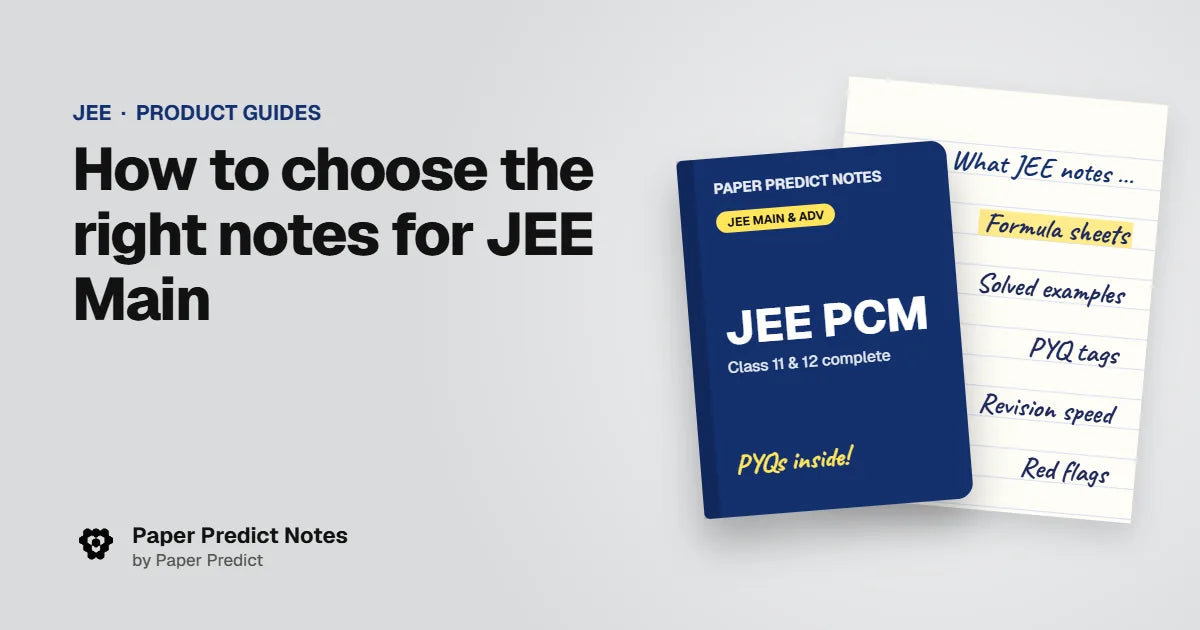
JEE Main preparation produces mountains of paper. Coaching modules, DPPs, test papers, reference books and printed solutions pile up quickly, and by Class 12 many students find it hard to revise from any of them. Notes are meant to fix that, but notes for JEE have to do a different job from notes for boards.
Board answers are marked for content and presentation. JEE is a problem-solving exam with strict time limits, where recognising the right concept quickly matters as much as knowing it. This guide covers what good JEE notes should contain, subject by subject, and how to use them alongside the problem practice that JEE demands.

What JEE Main rewards
JEE Main has 25 questions in each of Physics, Chemistry and Mathematics, usually 20 multiple-choice questions and 5 numerical-value questions per subject. Check the latest NTA bulletin for your year's exact pattern.
Three features of the exam shape what good notes look like.
- Speed. You need to identify the concept behind a question within seconds.
- Formula recall with conditions. Many mistakes come from using a formula outside the conditions where it applies.
- Numerical-value questions. With no options to check against, your method and arithmetic have to be reliable.
What good JEE notes must include
Formula sheets with conditions and units
A list of formulas is not enough. For each formula, notes should state when it applies, what each symbol means, and its units. "Valid only for constant acceleration" or "only for an ideal gas" is the kind of line that saves marks.
Concepts explained briefly, then applied
JEE notes should explain a concept clearly in a few lines, then show it in action through one or two solved examples. Long theory without examples is better left to textbooks.
Common traps and edge cases
Good notes point out where students usually go wrong: sign conventions in optics, direction of friction, limits that look like indeterminate forms, or exceptions in periodic trends.
PYQ tags
Previous year JEE Main questions placed next to the relevant topic show how the concept is tested. Over time you will see which topics tend to appear as numerical-value questions and which as MCQs.
A consistent structure across all three subjects
When every chapter follows the same layout, you can revise quickly without hunting for the formula sheet or examples.
Physics notes
Physics notes for JEE should include:
- Every formula in the chapter, grouped by topic, with conditions and units.
- Free-body diagram conventions for mechanics, and clear sign conventions for optics and electrostatics.
- Graphs such as velocity-time, potential energy curves and characteristic curves, with what their slope and area represent.
- Standard results that save time, for example moments of inertia of common bodies or field due to standard charge distributions.
- Solved examples that cover the most common problem types for each topic.
The heaviest areas, Mechanics and Electrodynamics, need the most space. Modern Physics and Optics are often quick to revise and scoring.
Chemistry notes
Chemistry notes need to work differently for each branch.
Physical Chemistry
- Formulas with conditions and units.
- One solved numerical per formula type.
- Graphs for kinetics, equilibrium and colligative properties.
Organic Chemistry
- A strong General Organic Chemistry section on electronic effects and the stability of intermediates.
- Reaction maps showing how each functional group can be prepared and converted.
- Named reactions with reagents and conditions, ideally with memory aids.
- Mechanisms for the reactions most often tested.
Inorganic Chemistry
- Periodic trends with exceptions clearly marked.
- Structures and shapes from VSEPR and hybridisation.
- Coordination compounds: nomenclature, isomerism and crystal field basics.
- Lists of important compounds, colours and properties, closely following NCERT.
Inorganic is the branch where JEE stays closest to NCERT, so notes should keep NCERT wording.
Revise this faster: JEE PCM Complete Notes — handwritten, colour-coded notes with points often asked, PYQs and tricks in every chapter.
Maths notes
Maths notes for JEE are mostly about methods and standard results.
- Standard formulas and identities for each chapter, from trigonometry to coordinate geometry.
- Methods, written as short step-by-step approaches: how to tackle a definite integral using properties, or how to find the locus of a point.
- Shortcuts such as standard results for conics or properties of determinants, with when they apply.
- Graphs of standard functions, which help with limits, continuity and area problems.
- Solved examples that cover each common question type.
Calculus, Algebra and Coordinate Geometry usually need the most space.
Red flags in JEE notes
- Formulas without conditions. These cause more errors than they prevent.
- Notes that are mostly theory. JEE notes need examples and methods.
- Outdated syllabus. Topics removed from the JEE Main syllabus should not take up space.
- Errors in solved examples. Check a few examples from a chapter you know well.
- Inconsistent layout. Notes assembled from different sources are slow to revise from.
How to check a set before buying
- Open a chapter you know well, such as Rotational Motion, Chemical Equilibrium or Definite Integration.
- Check the formula list against your coaching material. Are any missing? Are conditions stated?
- Try three solved examples without looking at the solutions, then compare methods.
- Look for PYQ tags and check whether they cover recent sessions.
- Revise from it for 30 minutes, then write down every formula you remember.
How to use notes in JEE preparation
Notes are for revision, practice is for rank
The biggest mistake JEE students make with notes is reading them too much and solving too little. Notes help you remember and organise. Rank comes from solving a large number of problems accurately and quickly.
A weekly pattern that works
- Before practice: spend ten minutes revising the chapter's formula sheet and methods.
- During practice: solve without looking at notes. When stuck, check the method in your notes, then try again.
- After practice: add any new trap or method to your notes or your error log.
In the final months
Revise every formula sheet at least once a week. Use Organic reaction maps daily. Read Inorganic sections repeatedly in short sessions. Keep solving mixed problem sets and full mocks.
Notes and predicted questions
Predicted questions can help you choose which concepts to practise first. Paper Predict gives predicted questions with probability scores, verified by experts. Paper Predict reported 55% accuracy for JEE Main 2026 (April session). That is lower than for NEET, because JEE draws on a wider range of problem types and changes more between sessions, so use predictions to set priorities while keeping your problem practice broad.
See Paper Predict's accuracy reports ↗
Paper Predict Notes is the notes vertical of Paper Predict, and uses the same analysis to decide which formulas, traps and PYQs each chapter highlights.
Frequently asked questions
Are handwritten notes useful for JEE?
Yes, if they include formulas with conditions, methods and solved examples. They are especially useful for fast revision of formulas and Organic reactions.
Should I make my own JEE notes?
Making your own formula sheets is valuable. Making full notes for every chapter usually takes too much time in a JEE year. A good ready set plus your own additions works well.
Do JEE notes help with JEE Advanced?
The concepts and formulas are the same. Advanced needs deeper problem practice, so use notes for revision and spend more time on harder problems.
Can I use JEE notes for Class 12 boards?
They cover the concepts, but board answers need more writing practice and presentation. Add board-style answer practice before your boards.
The short version
Good JEE notes list every formula with conditions and units, explain concepts briefly and show them in solved examples, flag common traps, and tag PYQs by topic. Chemistry needs reaction maps for Organic and NCERT-close lists for Inorganic. Check a sample before buying, use notes to revise before and after practice, and spend most of your time solving problems.
About Paper Predict. Paper Predict is an AI-powered exam preparation platform; Paper Predict Notes is its notes vertical. See the accuracy reports.